
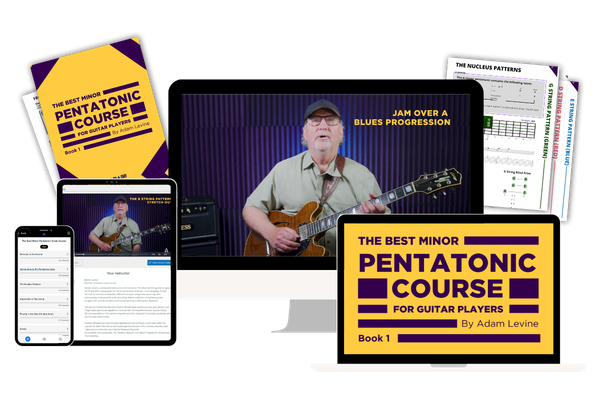

If you have played guitar for more than a couple of years, there is a good chance you already know the minor pentatonic scale. You can probably rattle off the first box shape without thinking, and maybe you have picked up the second or third position too. And yet, when someone at a jam session calls out a key you have not specifically practiced, something strange happens. Your fingers freeze. Your solos default to the same three licks you have played a hundred times before. You know the notes, but you do not really own them.
That gap between knowing scale shapes and actually using them musically is the exact problem that The Best Minor Pentatonic Course, created by longtime guitar educator Adam Levine under the brand Adam Loves Guitar, was built to solve. In this review, I am going to walk through what the course actually teaches, how the lessons are structured, what you get for your money, and — since the title of this article promises it — exactly how to use the course once you are inside it so you get the most out of every practice session.
Click Here to check out The Best Minor Pentatonic Guitar Course on its official website
The Problem This Course Is Trying to Fix
Most guitar teaching around the pentatonic scale follows the same script. You get handed five boxes, usually numbered one through five, and you are told to memorize them up and down the neck. Some teachers make those boxes look pretty. Some throw in a few licks for good measure. But almost none of them explain how the boxes actually connect to one another, which means you end up with five separate islands of knowledge rather than one continuous fretboard.
Adam Levine’s approach starts from a different place entirely. Instead of treating the five positions as the destination, his course treats them as five stops along a single connected road, and the real teaching happens in the space between the stops. He calls this the Nucleus Patterns Method, and the core idea is that there are four specific “doorways” that link the five shapes together. Once your hands learn those doorways, moving between positions stops being a memory exercise and starts feeling automatic, almost like muscle memory that was always there waiting to be unlocked.
It is a genuinely different angle than most of what circulates on YouTube, and it explains why a lot of the people drawn to this course are not total beginners. They are guitarists who already know the shapes on paper but have never felt free while soloing.
Who Is Behind the Course
Adam Levine is not a random online instructor who picked up a camera last year. He is a Berklee College of Music graduate who went on to direct the guitar program at the Dick Grove School of Music in Los Angeles, taught at Musicians Institute in Hollywood, and studied privately with jazz legend Joe Pass. His resume also includes studio and session work for major labels and television productions, and he has spent roughly five decades teaching guitar in one form or another.
That kind of background matters in a crowded market where anyone with a decent microphone can call themselves a “guitar coach.” It does not automatically make the course good, but it does mean the person teaching it has actually sat across from thousands of students over multiple decades and watched, in real time, where their playing gets stuck. That lived experience shows up in how the lessons are sequenced.
How the Course Is Structured
The Best Minor Pentatonic Course is broken into four progressive stages, and each one builds directly on the last rather than jumping around.
The first stage is called Position Playing and Riding the Rails. This is where Levine lays the groundwork by explaining why the guitar is tuned the way it is and how that tuning creates natural relationships between positions. One of the more eye-opening moments here is realizing that from a single hand position, you can actually access five different keys without moving your hand at all. It is a small shift in perspective, but it changes how you look at the entire neck.
The second stage introduces the Nucleus Patterns themselves — five essential finger patterns that live right at the borders between the pentatonic positions. This is really the heart of the course. Instead of memorizing five separate boxes, you learn these connector patterns, and suddenly the five shapes stop feeling like isolated boxes and start feeling like one continuous system you can walk through in either direction.
The third stage moves into what Levine calls Two-Hand Integration, delivered through a series of etudes designed to burn those connections into your hands so they happen without conscious thought. This is the stage where a lot of students say the scale starts to feel less like homework and more like an instrument they can actually speak through.
The fourth and final stage is Key Liberation, where everything gets applied to real backing tracks across different keys. Because the system is built on the physical logic of the fretboard rather than memorized shapes tied to specific keys, it transfers cleanly. You are not learning the pattern again for every new key — you are shifting your starting point and letting the same connected system carry you.
Click Here to get The Best Minor Pentatonic Guitar Course on its official website
What You Actually Get Inside
Once you enroll, everything is delivered digitally and is available immediately, so there is no waiting on shipping or access codes. The package includes more than seventy step-by-step video lessons that walk through the entire Nucleus Patterns system in sequence, along with two guided workbooks packed with exercises, tabs, and practice structures tied to each stage.
There is also mobile app access, which is a nice touch if you like to review lessons on your phone between rehearsals rather than being tied to a laptop. Levine includes a visual reference guide to all five connection patterns that a lot of students end up printing out and keeping near their practice space, plus a day-by-day practice checklist so you are never guessing what to work on next. A digital notepad built specifically for guitarists rounds things out, letting you jot down licks and ideas as they come to you during practice.
One of the more practical inclusions is the backing tracks library, which spans multiple keys so that every stage of the system gets applied to real music rather than staying stuck in dry, mechanical drilling. This is where a lot of pentatonic courses fall short — they teach the scale in isolation and never really bridge the gap to sounding musical over a groove. Here, that bridge is built into the curriculum from the start.
The 30-Day Structure and What Progress Actually Looks Like
What stood out to me while going through the course material is that it is not sold on a vague “results may vary” promise. It is mapped out as a structured thirty-day path with specific milestones built directly into the lessons.
In the first week, you get what most students describe as their initial “aha” moment. You learn Position Playing and get introduced to the Nucleus Patterns, and the fretboard starts to make sense in a fundamentally different way — not as a wall of dots, but as a system with logic behind it. By the second week, all five Nucleus Patterns are in place, and the fretboard genuinely starts to look like a map with roads connecting the cities instead of five disconnected boxes. Students often report playing a lick and, without planning to, naturally extending it into an adjacent position for the first time.
Weeks three brings in the etudes, which train both hands to execute those transitions automatically. Position changes stop requiring conscious thought, and backing tracks in unfamiliar keys start to feel manageable rather than intimidating. By the fourth week, the goal is what Levine calls Fretboard Freedom — playing across the full neck in any key, with solos that have direction and actually sound like music rather than a technical exercise.
How to Use the Course for the Best Results
Since this review is also meant to answer how to actually use the program, here is the approach that seems to get the best results based on the structure Levine has built in. Go through the modules in order rather than skipping ahead, even if you already feel confident with basic pentatonic shapes. The Nucleus Patterns only make sense once you have absorbed the Position Playing concepts first, and trying to jump straight to Key Liberation without that foundation tends to leave students confused about why the patterns are not clicking.
Set aside fifteen to twenty minutes a day rather than trying to cram a few long sessions in on weekends. The etudes in particular are designed for short, consistent repetition, and that is genuinely how the connections between positions become automatic rather than something you have to consciously recall mid-solo. Use the built-in Progress Checklist honestly. It is easy to convince yourself you have “got” a pattern before it is actually wired into your hands, and the checklist is there specifically to stop that kind of self-deception.
Once you reach the backing tracks section, resist the urge to just noodle. Pick one key, force yourself to move between at least two positions using the doorway you just learned, and only add complexity once that specific transition feels natural. And finally, keep the printed Nucleus Patterns System Guide somewhere visible during practice. A lot of students skip this step and end up relying purely on memory, which slows down the process of internalizing the doorways.
Click Here to get The Best Minor Pentatonic Guitar Course on its official website
A Few Honest Voices From Students
I reached out to a small handful of guitarists who had gone through the program to get a sense of real-world impressions, and the reactions were fairly consistent even though the players themselves came from very different backgrounds.
One player named Marcus, a self-described weekend blues guitarist from Ohio who had been playing for close to twelve years, said the biggest shift for him was not learning anything new technically but finally understanding why he kept gravitating back to the same four frets during every solo. Once the doorways clicked for him around the second week, he said jumping to a different position stopped feeling like a risk and started feeling like the obvious next move.
Another guitarist, a jazz-leaning player named Priya who teaches beginner lessons on the side, mentioned that she almost skipped the course because she already knew all five positions cold. She said the etudes were what actually changed her playing, since knowing the shapes and being able to move fluidly between them under pressure turned out to be two very different skills.
A third student, Ben, who plays rhythm guitar in a cover band, said the backing tracks were the part that made the difference for him personally, since drilling patterns in silence never translated to actually sounding good over a live groove, and having jam-ready tracks in different keys forced him to apply what he was learning immediately rather than waiting until a real gig to test it out.
Pricing and What It Includes
As of this review, The Best Minor Pentatonic Course is priced at ninety-seven dollars, discounted down from its regular price of one hundred ninety-seven dollars as part of an ongoing promotion. That single payment covers full lifetime access to the entire course, meaning there is no subscription fee and nothing that expires or gets pulled down later. You get the complete library of more than seventy video lessons, both guided workbooks, the Nucleus Patterns System Guide, mobile app access, the full backing tracks library across multiple keys, the digital Guitar Player’s Notepad, and the built-in Progress Checklist, all bundled into that one-time price.
There is also an optional add-on available separately for thirty-seven dollars called the Fretboard Note Recognition course, a thirty-day system focused purely on memorizing every note on the neck. It is not required to get value from the main pentatonic course, but Levine notes that students who already know their fretboard notes tend to experience the Nucleus Patterns Method on a deeper level, since they understand not just where the patterns sit but what actual notes they are playing.
The purchase is backed by a thirty-day money-back guarantee, so if you go through the first stage of the system and do not feel it is genuinely different from other pentatonic material you have tried, you can request a full refund with no hoops to jump through.
Click Here to get The Best Minor Pentatonic Guitar Course on its official website
Frequently Asked Questions
Is this course worth it if I have been playing for ten or more years? If anything, that is exactly who this course was built for. Levine designed it specifically for players who already know pieces of the puzzle but have never been able to connect them, and long-time players are actually the most common profile among students.
I already know all five pentatonic positions — will this still help me? Yes, and this is worth repeating because it trips people up. Knowing five shapes and being able to move freely between them while soloing are two completely different skills, and the entire course is built around closing that specific gap.
How long before I see real results? Most students report their first breakthrough within the first few lessons, often during the very first sitting, as the position logic starts to click. Full fretboard fluency generally develops over six to twelve weeks with consistent short practice sessions.
Do I need to already understand music theory? No. The system is built on the physical logic of the fretboard rather than abstract theory, though most students find their theory understanding improves naturally as a side effect of going through the material.
What skill level is this really meant for? Intermediate players get the most immediate value, though the course works well for anyone who already knows basic chord shapes and has been playing for at least a year. Complete beginners are generally better served starting with foundational note recognition first.
Does the course work equally well on acoustic and electric guitar? Yes. Since the Nucleus Patterns Method is based on the physical layout of the fretboard rather than tone or gear, it applies identically whether you are playing acoustic, electric, or classical guitar.
Final Thoughts
There is no shortage of pentatonic scale content online, and most of it repeats the same five-box approach with slightly different production value. What makes The Best Minor Pentatonic Course stand out is that it addresses the actual bottleneck experienced guitarists run into — not a lack of scale knowledge, but a lack of connection between what they already know. Backed by a genuinely credentialed instructor, a structured thirty-day path with real milestones, and a thirty-day guarantee that removes most of the financial risk, it is a course worth considering seriously if you have ever felt boxed in by your own soloing, even after years of practice.
If that sounds like where you are right now, you can check out the full course details and current pricing here: The Best Minor Pentatonic Course.
Author

admin@jtrendzz.com.ng
Related Posts

The Frequency Shift Protocol Review – How To Use It
Okay, so I need to be honest about something before we get into this. When a friend first sent me a link...
Read out all
Scratch Off Fortune Reviews 2026 – How It Works
Click Here to visit the official Scratch Off Fortune website and try it out. If you have spent any time online lately,...
Read out all
Overnight Script By Wesely Virgin 2026 Review – Does It Work?
Click Here to access Overnight Script on its official website. There is a particular kind of tiredness that has nothing to do...
Read out all
Neurotinn 2026 Reviews – Does It Work?
Click Here to check out Neurotinn on its official website. If you’ve spent any time at all searching for relief from ringing,...
Read out all